Search results for: “california”

  • Grateful Dead – From The Mars Hotel

    Here’s a review from a guy named Doug Collette on All About Jazz:

    Serendipity is dead! Grateful Dead that is.

    A successor to the similarly massive and comparably gorgeous box set The Golden Road (1965-1972) , Beyond Description (1973-1989) depicts the latter day Grateful Dead’s utter and perhaps naive willingness to surrender to their muse for inspiration, whether it be on the stage or in the studio. It becomes quite clear before you are even half-way through these dozen extended remastered CDs that, when this band was struck with inspiration, there was hardly one better. When they were not enlightened with ideas, either new or old, they were as nondescript as any anonymous bar band in the land.

    And different things could inspire the Dead. With Wake of the Flood , it was no doubt the sense of creative freedom from the corporate business pressures of the major label (Warner Bros) they’d just left to begin their own career as an independent rival. Before the difficulties of that role set in, combined with the sieve-like drain on their resources presented by their self-designed wall of sound system for the road, the misrouted trip to the Egyptian pyramids and the naive dive into movie making, the collective spirit of ingenuity gave birth to Blues for Allah , without a doubt the finest studio rendition of Grateful Dead improvisation ever to be captured on tape without a paying audience.

    Their existence in the recording studio had its positive and negative effect on the band throughout its career right up til the end. Guitarist/songwriter Jerry Garcia’s idea to have the band play ‘live’ for In the Dark was counterpointed by the layered approach of Built to Last where individuals composed their parts only to be assembled after the fact. That’s sort of like taking the Swiss watch apart then putting it back to together again, but at least there was a theme to the fundamental ideas behind those sessions: Shakedown Street , for all its good material—at least four cuts from this album became live staples—suffers terribly for an almost absentminded lack of focus.

    Given the ingenuous nature of this band, it’s perhaps little surprise that one of their most pure instances of inspiration—Garcia and lyricist Robert Hunter’s near-simultaneous creative epiphany giving birth to “Terrapin Station”—would end up one of their most seriously tainted projects. For this, their first record for Arista—founded by the archetypal record mogul Clive Davis as an expatriate of behemoth Columbia Records—Grateful Dead deferred to producer Keith Olsen, fresh off his mammoth success with Fleetwood Mac, who orchestrated stings and vocal choir for this epic piece; a tighter more concise arrangement, emphasizing the spaces between the pieces of the suite rather than filling those spaces, would’ve been much preferable. The melodrama on the studio version is almost laughable, especially given what the band, even so recently as this summer, was able to do with the piece in concert, and the fact that melodrama is virtually alien to this group that brought new meaning to the word understatement.

    Digesting the expanded versions of these studio efforts reveals just how the Grateful Dead’s idiosyncratic nature wasn’t refused free reign by the likes of then-hot producers such as Gary Lyons (Foreigner, Aerosmith). His cookie-cutter approach on Go to Heaven renders the band’s amorphous essence virtually indecipherable on the album as originally released, but then the Dead didn’t do much to make themselves a more pronounced factor in the proceedings: Bob Weir could be the essence of convention and new recruit Brent Mydland, despite the vocals and varied keyboard work that added contemporary colors to the collective palette, only added to the general sense of anonymity. But as astutely noted in the album summary, the live versions of “Althea,” one of a pair of Garcia/Hunter compositions on the album, plus the natural pairing of Weir’s “Lost Sailor” and “Saint of Circumstance,” reveal the Dead hadn’t lost their essential character—it’d been simply lost in the process of producing the album. The same revelation arises from the studio outtakes such as “Peggy-O:” Lyons’ unsympathetic tweaking of the recorded sound lost the drums interplay and the resounding drive and ingenuity of Lesh’s basswork.

    Little wonder given such less-than-satisfactory incidents the Dead felt more comfortable playing on a stage in front of an audience than in a recording studio, even if the environment had been contrived for their own benefit (Garcia conceived Workingman’s Dead with an angle to economics of musicianship as well as studio costs, with the pithy approach of Buck Owens’s Bakersfield CA country music as a template). And all this is not to suggest that these San Francisco icons had any more difficulty in the studio than many other artists, improvisationally-oriented or not:their 1986 touring partner/peer Bob Dylan has been at least as lackadaisical as the Dead, if not more so. Certainly, though, to listen to the two-double disc expanded live albums included in this ornately- designed box set is to understand Grateful Dead benefited from the mutual camaraderie of each other and their audience in front of the stage more than most, if not all, rock and roll bands.

    Such an obviously high comfort level allowed them to stage the multi-night runs in California and New York in 1980 that make up Reckoning and Dead Set. The former is a compilation of the acoustic sets played as openers for those shows, an understated but hardly less amazing amalgam of originals and roots of their folk/country/bluegrass originals.

    This may be the sleeper of this collection, aptly described by essayist Gary Lambert (with the perceptive objectivity and obvious affection that also earmarks long-time publicist Dennis McNally’s history of the band as well as the other individual stories behind the albums) as a collection of Dead originals that naturally lent themselves to the folkish treatment [”Dire Wolf”], staples of the band’s electric configuration [”Cassidy”] that translated into superb acoustic jamming vehicles, some never to be repeated rarities [”Rosalie McFall”], and a bunch of well-chosen covers [”The Race Is On”].” Certainly the mix of acoustic guitars, enriched by Bill Kretutzmann and Mickey Hart percussion compares favorably with the Dead’s rock alignment, especially when accented by keyboardist Brent Mydland with the unconventional spirit he brought to the Dead—harpsichord on “Dark Hollow” is a starling yet appropriate change of pace from the acoustic piano that underscores the traditional feel of these sets.

    And the band plays with equal amounts economy and exploratory zeal, throughout the two extended discs, offering more insight and more music than the original lp issue. Those characteristics mirror the jaunty approach of the electric companion piece Dead Set. The full-speed ahead propulsion in Phil Lesh’s great rocker “Passenger” is offset, proportionately, by the stillness of “Row Jimmy.”

    In direct dynamic contrast to their brethren The Allman Brothers Band, who utilize the simplicity of the blues to connect directly to polar emotions of agony and ecstasy, The Dead’s wider influences virtually guarantee a mix of emotions as well as a roundabout means of reaching them and, in turn, expressing them, to their listeners. It’s the difference between pastel shades and bolder strokes of deeper color.

    Whatever their miscues in the recording studio, it’s a tribute to Grateful Dead’s integrity they did not compromise themselves on stage and the live selections throughout this collection confirm that, generally speaking, it’s fascinating to follow one of their group improvisations even if it doesn’t lead to a truly galvanizing moment, the likes of which their legend is built. Not every truly great conversation, musical or otherwise, necessarily leads to an epiphany.

    It’s to the credit of the producers of Beyond Description , David Lemieux and James Austin that, in particular with these live albums, they made no attempt to re-create them, but simply add on to them (besides, how do you create an alternate version of an alternate universe, which is what Grateful Dead music signified, at both its high and low points?). Yet it’s a matter of practicality too, because the bulk of the bonus tracks on the studio CDs are concert cuts rather than sterling alternate studio takes or unreleased recordings that would conceivably reinvent the original. This selection of albums may not compare with those in the previously-released box, including American Beauty and Europe ’72 , but the fact of the matter is, the deep, crystalline sound quality bestowed upon these recordings through HDCD remastering—by Joe Gastwirt whose name in credits almost guarantees great sound— makes the music worth hearing, despite its erratic nature, from disc to disc and sometimes, as in Wake of the Flood , from track to track. And it’s no coincidence that, even when it’s a curiosity like Lowell George singing “Dancing in the Street,” the extra tracks are superior to most of those included in the prior box. And how great is hindsight: after three successive duds overseen by commercial producers, the Dead scored their ‘hit’ supervising themselves in the studio!?

    The distinction of the live package Reckoning as presented in Beyond Description might not have been so clear except in retrospect. Take the well of influences shared by the members of the band: as broad as it was deep, Bob Weir, contrary to his perpetually boyish persona, knew jug- band music arguably as intimately as Garcia, who was asked to join the former’s band pre-electric Dead! It’s little surprise, either, that the marathon sets of five-hours plus from which these recordings are taken derive much of their impact from the cumulative effect of the sets. Just as some of the sequencing on Dead Set does little to generate continuity—you contend it actually disrupts the momentum, such as it is—it likewise illuminates the source of the catchphrase of the times “there (was) nothing like a Grateful Dead concert.”

    Up until the band hit the mainstream so resoundingly with “Touch of Grey,” their self-generated community created a culture within a culture, where few if any of the rules generally accepted by society were in effect. If you accept this phenomenon as a direct outgrowth of the band’s own laisezz faire ethos, where they open up to their muse rather than chasing it, then you understand instinctively how the music took something of a downturn as the Dead’s audience grew to include many for whom the music was not of primary importance: the immediate feedback of the audience was lessened (might this explain the Dead’s resurgence in interest toward the studio?).

    Like a scrapbook assembled with loving care, the two booklets included in the box, brimming with photos, information and insight (not to mention timeless memorabilia), offer an accurate subtext to a tale told with picturesque detail and a joyful sense of adventure in both the songs and the playing of them. Yet the most practical value of Beyond Description (1973-1989) is its focus on a phase of the Grateful Dead’s existence that is as often misperceived as it is overlooked. For instance, the early studio albums that are part of this set, especially From the Mars Hotel , should benefit tremendously from a rethink and, ultimately, these unsung facets of the group’s existence deserve this lovingly-detailed, scholarly-researched, high-tech documenting. None of us, archivists, casual listeners or devout Deadheads, should fool ourselves into thinking we’ve definitively captured the Grateful Dead here, but as chief archivist Lemieux suggests ever so forcefully in his general introduction, as the Dead’s legacy continues a veritable work-in-progress. their music remains a living breathing entity.

    Visit the Grateful Dead on the web.
  • Grateful Dead – Wake Of The Flood

    Here’s a review from a guy named Doug Collette on All About Jazz:

    Serendipity is dead! Grateful Dead that is.

    A successor to the similarly massive and comparably gorgeous box set The Golden Road (1965-1972) , Beyond Description (1973-1989) depicts the latter day Grateful Dead’s utter and perhaps naive willingness to surrender to their muse for inspiration, whether it be on the stage or in the studio. It becomes quite clear before you are even half-way through these dozen extended remastered CDs that, when this band was struck with inspiration, there was hardly one better. When they were not enlightened with ideas, either new or old, they were as nondescript as any anonymous bar band in the land.

    And different things could inspire the Dead. With Wake of the Flood , it was no doubt the sense of creative freedom from the corporate business pressures of the major label (Warner Bros) they’d just left to begin their own career as an independent rival. Before the difficulties of that role set in, combined with the sieve-like drain on their resources presented by their self-designed wall of sound system for the road, the misrouted trip to the Egyptian pyramids and the naive dive into movie making, the collective spirit of ingenuity gave birth to Blues for Allah , without a doubt the finest studio rendition of Grateful Dead improvisation ever to be captured on tape without a paying audience.

    Their existence in the recording studio had its positive and negative effect on the band throughout its career right up til the end. Guitarist/songwriter Jerry Garcia’s idea to have the band play ‘live’ for In the Dark was counterpointed by the layered approach of Built to Last where individuals composed their parts only to be assembled after the fact. That’s sort of like taking the Swiss watch apart then putting it back to together again, but at least there was a theme to the fundamental ideas behind those sessions: Shakedown Street , for all its good material—at least four cuts from this album became live staples—suffers terribly for an almost absentminded lack of focus.

    Given the ingenuous nature of this band, it’s perhaps little surprise that one of their most pure instances of inspiration—Garcia and lyricist Robert Hunter’s near-simultaneous creative epiphany giving birth to “Terrapin Station”—would end up one of their most seriously tainted projects. For this, their first record for Arista—founded by the archetypal record mogul Clive Davis as an expatriate of behemoth Columbia Records—Grateful Dead deferred to producer Keith Olsen, fresh off his mammoth success with Fleetwood Mac, who orchestrated stings and vocal choir for this epic piece; a tighter more concise arrangement, emphasizing the spaces between the pieces of the suite rather than filling those spaces, would’ve been much preferable. The melodrama on the studio version is almost laughable, especially given what the band, even so recently as this summer, was able to do with the piece in concert, and the fact that melodrama is virtually alien to this group that brought new meaning to the word understatement.

    Digesting the expanded versions of these studio efforts reveals just how the Grateful Dead’s idiosyncratic nature wasn’t refused free reign by the likes of then-hot producers such as Gary Lyons (Foreigner, Aerosmith). His cookie-cutter approach on Go to Heaven renders the band’s amorphous essence virtually indecipherable on the album as originally released, but then the Dead didn’t do much to make themselves a more pronounced factor in the proceedings: Bob Weir could be the essence of convention and new recruit Brent Mydland, despite the vocals and varied keyboard work that added contemporary colors to the collective palette, only added to the general sense of anonymity. But as astutely noted in the album summary, the live versions of “Althea,” one of a pair of Garcia/Hunter compositions on the album, plus the natural pairing of Weir’s “Lost Sailor” and “Saint of Circumstance,” reveal the Dead hadn’t lost their essential character—it’d been simply lost in the process of producing the album. The same revelation arises from the studio outtakes such as “Peggy-O:” Lyons’ unsympathetic tweaking of the recorded sound lost the drums interplay and the resounding drive and ingenuity of Lesh’s basswork.

    Little wonder given such less-than-satisfactory incidents the Dead felt more comfortable playing on a stage in front of an audience than in a recording studio, even if the environment had been contrived for their own benefit (Garcia conceived Workingman’s Dead with an angle to economics of musicianship as well as studio costs, with the pithy approach of Buck Owens’s Bakersfield CA country music as a template). And all this is not to suggest that these San Francisco icons had any more difficulty in the studio than many other artists, improvisationally-oriented or not:their 1986 touring partner/peer Bob Dylan has been at least as lackadaisical as the Dead, if not more so. Certainly, though, to listen to the two-double disc expanded live albums included in this ornately- designed box set is to understand Grateful Dead benefited from the mutual camaraderie of each other and their audience in front of the stage more than most, if not all, rock and roll bands.

    Such an obviously high comfort level allowed them to stage the multi-night runs in California and New York in 1980 that make up Reckoning and Dead Set. The former is a compilation of the acoustic sets played as openers for those shows, an understated but hardly less amazing amalgam of originals and roots of their folk/country/bluegrass originals.

    This may be the sleeper of this collection, aptly described by essayist Gary Lambert (with the perceptive objectivity and obvious affection that also earmarks long-time publicist Dennis McNally’s history of the band as well as the other individual stories behind the albums) as a collection of Dead originals that naturally lent themselves to the folkish treatment [”Dire Wolf”], staples of the band’s electric configuration [”Cassidy”] that translated into superb acoustic jamming vehicles, some never to be repeated rarities [”Rosalie McFall”], and a bunch of well-chosen covers [”The Race Is On”].” Certainly the mix of acoustic guitars, enriched by Bill Kretutzmann and Mickey Hart percussion compares favorably with the Dead’s rock alignment, especially when accented by keyboardist Brent Mydland with the unconventional spirit he brought to the Dead—harpsichord on “Dark Hollow” is a starling yet appropriate change of pace from the acoustic piano that underscores the traditional feel of these sets.

    And the band plays with equal amounts economy and exploratory zeal, throughout the two extended discs, offering more insight and more music than the original lp issue. Those characteristics mirror the jaunty approach of the electric companion piece Dead Set. The full-speed ahead propulsion in Phil Lesh’s great rocker “Passenger” is offset, proportionately, by the stillness of “Row Jimmy.”

    In direct dynamic contrast to their brethren The Allman Brothers Band, who utilize the simplicity of the blues to connect directly to polar emotions of agony and ecstasy, The Dead’s wider influences virtually guarantee a mix of emotions as well as a roundabout means of reaching them and, in turn, expressing them, to their listeners. It’s the difference between pastel shades and bolder strokes of deeper color.

    Whatever their miscues in the recording studio, it’s a tribute to Grateful Dead’s integrity they did not compromise themselves on stage and the live selections throughout this collection confirm that, generally speaking, it’s fascinating to follow one of their group improvisations even if it doesn’t lead to a truly galvanizing moment, the likes of which their legend is built. Not every truly great conversation, musical or otherwise, necessarily leads to an epiphany.

    It’s to the credit of the producers of Beyond Description , David Lemieux and James Austin that, in particular with these live albums, they made no attempt to re-create them, but simply add on to them (besides, how do you create an alternate version of an alternate universe, which is what Grateful Dead music signified, at both its high and low points?). Yet it’s a matter of practicality too, because the bulk of the bonus tracks on the studio CDs are concert cuts rather than sterling alternate studio takes or unreleased recordings that would conceivably reinvent the original. This selection of albums may not compare with those in the previously-released box, including American Beauty and Europe ’72 , but the fact of the matter is, the deep, crystalline sound quality bestowed upon these recordings through HDCD remastering—by Joe Gastwirt whose name in credits almost guarantees great sound— makes the music worth hearing, despite its erratic nature, from disc to disc and sometimes, as in Wake of the Flood , from track to track. And it’s no coincidence that, even when it’s a curiosity like Lowell George singing “Dancing in the Street,” the extra tracks are superior to most of those included in the prior box. And how great is hindsight: after three successive duds overseen by commercial producers, the Dead scored their ‘hit’ supervising themselves in the studio!?

    The distinction of the live package Reckoning as presented in Beyond Description might not have been so clear except in retrospect. Take the well of influences shared by the members of the band: as broad as it was deep, Bob Weir, contrary to his perpetually boyish persona, knew jug- band music arguably as intimately as Garcia, who was asked to join the former’s band pre-electric Dead! It’s little surprise, either, that the marathon sets of five-hours plus from which these recordings are taken derive much of their impact from the cumulative effect of the sets. Just as some of the sequencing on Dead Set does little to generate continuity—you contend it actually disrupts the momentum, such as it is—it likewise illuminates the source of the catchphrase of the times “there (was) nothing like a Grateful Dead concert.”

    Up until the band hit the mainstream so resoundingly with “Touch of Grey,” their self-generated community created a culture within a culture, where few if any of the rules generally accepted by society were in effect. If you accept this phenomenon as a direct outgrowth of the band’s own laisezz faire ethos, where they open up to their muse rather than chasing it, then you understand instinctively how the music took something of a downturn as the Dead’s audience grew to include many for whom the music was not of primary importance: the immediate feedback of the audience was lessened (might this explain the Dead’s resurgence in interest toward the studio?).

    Like a scrapbook assembled with loving care, the two booklets included in the box, brimming with photos, information and insight (not to mention timeless memorabilia), offer an accurate subtext to a tale told with picturesque detail and a joyful sense of adventure in both the songs and the playing of them. Yet the most practical value of Beyond Description (1973-1989) is its focus on a phase of the Grateful Dead’s existence that is as often misperceived as it is overlooked. For instance, the early studio albums that are part of this set, especially From the Mars Hotel , should benefit tremendously from a rethink and, ultimately, these unsung facets of the group’s existence deserve this lovingly-detailed, scholarly-researched, high-tech documenting. None of us, archivists, casual listeners or devout Deadheads, should fool ourselves into thinking we’ve definitively captured the Grateful Dead here, but as chief archivist Lemieux suggests ever so forcefully in his general introduction, as the Dead’s legacy continues a veritable work-in-progress. their music remains a living breathing entity.

    Visit the Grateful Dead on the web.
  • riaa

    link to RIAA vs The People blog

    link to RIAA Radars Amazon top 100 safe site

    {mospagebreak}

    From: Merl Ledford III, Esq. [mailto:[email protected]]
    Sent: Tuesday, March 27, 2007 1:11 AM
    To: Thomas McCarten Kerr, Esq
    Cc: Barry Merchant
    Subject: Sony BMG et al. v. Merchant Eastern Dist of Cal. Sacramento Branch 2:07-CV-00340-DFL-DAD

    Dear Mr. Kerr

    Thank you for your letter of March 23, 2007 received in my office today. I did not receive a copy of the letter by PDF although that method of delivery was shown on the letter.

    Incorrect Venue and Emotional Distress

    The lawsuit filed by your office and your letter arrive at a particularly inappropriate time in Barry and Cathy Merchant’s life. Mrs. Merchant left my office after our first meeting to attend to ill father in Colorado. She and Barry Merchant left my office today to attend his funeral. You should advise your clients that they are facing a "thin skull plaintiff" either on a Rule 11 sanctions motion or (upon favorable termination) in a malicious prosecution action. The emotional distress inflicted by your clients’ litigation — filed in Sacramento rather than the Fresno Branch of the Eastern District Court where my clients’ live in violation of the Rules of Court — has been extreme.

    Your client should carefully consider whether it has probable cause to proceed at this point. Mr. Merchant’s hard drive is available for immediate, carefully supervised inspection by your client; a carbon copy of the drive has been made by technicians to insure that the evidence is well backed-up.

    At the time of inspection, we will expect your clients to be prepared to dismiss all claims with prejudice. The pleadings may be e-filed from my office the same day. Although dismissal will not avoid your clients’ exposure to attorneys’ fees under the Copyright Act, it will certainly mitigate damages to Mr. and Mrs. Merchant and the possibility of escalating the issues by counter-claim on federal grounds that have been successfully pleaded in other states as well as on pendant California claims that have, thus far, tempered your clients’ California zeal for litigating in this state.

    Selling a Settlement and the AOL Subpoena

    I have evidence of one letter dated June 5, 2005 from an attorney in your firm who is not licensed to practice law in California to Mr. Merchant claiming copyright infringement and demanding settlement negotiations. There is no other record of any kind.

    Please provide copies of other correspondence that your clients claim was received by Mr. Merchant (whether by AOL or others) demanding settlement. Is it the same AOL letter that your clients’ represented was sent by AOL to a woman with MS who lives in the New York borough of Queens. See Elektra v. Schwartz, Cent Dist NY, 1:06-cv-03533-DGT-RML, Document 21). When the letter was finally produced, after objection and delay, it became clear that its contents had been misrepresented to the Court. (How anyone from the former Gray Cary firm ever pull such a stunt stuns me; it used to be such a fine office.)

    Also, please provide my office with copies of all telephone records of contacts your clients claim to have had with Mr. or Mrs. Merchant, and (with respect to your discussion of the AOL subpoena), proofs of service of Notice of Opportunity to Appear and Oppose RIAA’s subpoena, a copy of the subpoena, and all of the parties’ pleadings in support and opposition to issuance of the subpoena. In the event the AOL litigation named Doe defendants in violation of the Federal Rules of Civil Procedure and obtained any information regarding Mr. Merchant’s long-standing without appropriate notice or in violation of California consumer privacy laws, I will request a preclusion order barring any use or derivative use of any information so obtained. See, e.g., Fonovisa v. Does 1-41, W.D. Texas, Austin Div. 04-CA-550 LY.

    Independent Factual Investigation and Probable Cause to Sue: Background

    Your office has a duty of good faith independent factual investigation and legal research sufficient to support a finding of probable cause to sue.

    In Williams v. Coombs (1986) 179 Cal. App. 3d 626, the California Court of Appeal held that attorneys who participate in the filing or maintenance of litigation without probable cause are personally liable for malicious prosecution of a civil action.

    In Sheldon Appel Co. v. Albert & Oliker (1989) 47 Cal. 3d 863, the California Supreme Court narrowed Williams, holding that a trial court may not delegate the ultimate determination of probable cause to the jury; it held that the question was one of law which must be resolved by the Court. Id. at 876. The Sheldon decision specifically disapproved of dicta from Tool Research & Engineering Corp. v. Henigson (1975) 46 Cal. App. 3d 675, at 683, that the attorney must have a "subjective belief" in the tenability of his or her client’s claim in order to avoid malicious prosecution liability. Sheldon Appel Co. v. Albert & Oliker, supra, 47 Cal. 3d at 881. It nevertheless "strongly emphasized" that its conclusion "does not by any means suggest that an attorney who institutes an action which he does not believe is legally tenable is free from the risk of liability" because the lawyer’s subjective belief "would clearly be relevant to the question of malice." Id. (emphasis supplied); see also Slater v. Durchfort (1995) 35 Cal. App. 4th 1718, 1724.

    The Shelton Court also disapproved of Tool Research dicta suggesting that lack of probable cause may be proven "simply by showing that [the attorney] failed to perform reasonable legal research or factual investigation before filing a claim." Id. at 882. Rather, the Shelton Court held that such lack of diligence is relevant on the issue of malice. Id. The Shelton Court specifically disapproved of the Williams decision’s apparent use of lack of investigation to prove lack of probable cause, although it fully endorsed the Williams analysis of the tort of malicious prosecution itself. Id. at 882-883 (footnote 9).

    Although malicious prosecution was once characterized as a “disfavored action,” it has been somewhat expanded in recent years in apparent frustration with continued "shotgun" lawyering tactics by Plaintiff’s counsel. In Crowley v. Katleman (1994) 8 Cal. 4th 666, the California Supreme Court upheld a malicious prosecution complaint where only five of six underlying causes of action were alleged to have been brought without probable cause. The court specifically rejected the defendant’s claim that because one of the original causes of action was based on probable cause, the entire complaint was made immune from malicious prosecution liability. Id. at 694-695. Similarly, in Zamos v. Stroud (2004) 32 Cal.4th 1297b, the Court endorsed an action against an anti-SLAPP motion where a litigant’s counsel filed and maintained causes of action without probable cause.

    Independent Factual Investigation and Probable Cause to Sue: Lack of Probable Cause

    I know of no facts on which a good faith finding of probable cause by either your clients or your law firm could be based to support a claim for relief against Mr. Merchant.

    It is well documented that your clients’ reliance on MediaSecurity (an admitted "non-expert;" UMG v. Lidor, East Dist NY No. 1:05-cv-01095-DGT-RML) and its overall method of identifying P2P copyright infringers is wholly unreliable and inadequate. See, e.g., February 23, 2007, deposition of the RIAA’s expert. http://www.ilrweb.com/viewILRPDF.asp?filename=umg_lindor_070223JacobsonDepositionTranscript. See also expert witness statement of Prof. Pouwelse and Dr. Sips: http://www.ilrweb.com/viewILRPDF.asp filename=foundation_upcnederland_witnessdeclaration and amicus curiae brief of the ACLU, Public Citizen, Electronic Frontier Foundation, American Association of Law Libraries, and ACLU Foundation of Oklahoma, in Capitol v. Foster decrying the RIAA’s "driftnet" litigation strategy: http://www.ilrweb.com/viewILRPDF.asp?filename=capitol_foster_amicus.

    Such facts were known or reasonably should have been known to you and your law firm before suit against Mr. Merchant was filed. Thus, unless you and your office undertook additional independent investigation to identify Mr. Merchant as a person who actually has engaged in copyright infringement by illegal downloading, good faith basis for a Rule 11-compliant probable cause finding consistent with the Williams line of cases cited above simply did not exist to file the action. . . and does not exist now for it to be maintained.

    Your clients apparently argue that Mr. Merchant’s failure to respond to "settlement" demands justifies their lawsuit without other basis on which a finding of probable cause to sue could be claimed. You devoted the bulk of your letter advocating that position. As you know, however, that posture is repugnant to both Rule 408, Fed.Rul.Evid. and California Evidence Code §§ 1152 and 1154.

    The Evidence Code sections are quite clear: settlement negotiations of all kinds may not be used to prove the validity of any claim or defense. Mr. Merchant has and had no more duty to respond to attempts to "sell" him one of your clients’ boilerplate, non-negotiable $3750 settlements than he has to return cold calls from pushy life insurance salespeople. If your client (and your law firm?) are seeking probable cause shelter in a settlement negotiations house of straw (as suggested by your March 23 letter), all of you should consider the prevailing winds of the Evidence Code before making yourselves too comfortable. Straw is will burn.

    Your client take the position that my middle-aged, conservative clients should speculate regarding the identity of persons your clients’ claim used their AOL account to download pornographic-lyric gangsta rap tracks as predicate to possible case resolution. In an age of Wintel-virus created bot-farms, spoofs, and easily cracked WEP encrypted wireless home networks (among other easy hacks), the only tech-savvy response to such a request is, "You’ve got to be kidding." The extensive press that has been generated over computer security (and the insecurity of Windows XP and its predecessors) underscores the complete absence of facts on which probable cause to sue my clients could be established and your clients’ willingness (even insistence) that others be implicated in Big Music’s speculative, "driftnet" litigation tactics. Sorry: Mr. Merchant cannot and will not expose himself to still more litigation by speculating.

    Settlement Option

    It is not too late to correct your clients’ (and your law firm’s) mistakes.

    Mr. and Mrs. Merchant’s emotional condition puts a premium on immediate case resolution. Thus, although I generally do not make opening legitimate offers as defense counsel, the clients’ non-monetary interests and their probability of recovering their fees and costs in this matter (at a minimum) suggest that a defense settlement offer would not be inappropriate. Therefore:

    My clients are willing to accept dismissal of the litigation in exchange for

    1. Payment of Mr. Merchant’s reasonable fees and costs including retainer of $6,880.25. The payment represents good value considering what your own firm’s billings will have been to date and use of those billing records as the loadstar rate for Mr. Merchant’s award. See Capitol Record v. Foster, Western Dist. Okla No. 5:04-cv-1569-W, Docment 182 filed 3-15-07).

    2. Apology on your firm’s letterhead by your supervising partner for inappropriately filing and maintaining an action against Mr. Merchant without probable cause and for the emotional hardship that such litigation caused; and

    3. Execution of a mutual general release of all claims in my office’s usual form. The RIAA form of release I have seen will not be used. It is my practice in these kinds of cases to require that the plaintiffs indemnity my clients against claims by third parties as part of my general release language. (E.g., your clients sue a site for posting guitar tabs to copyrighted music; my client visits the site, read the tabs, plays them on his guitar, and get sued by way of cross-claim by the guitar tab site). My form of release also anticipates class action litigation that is in the works at several SoCal class-action offices on RICO, Unfair Practices Act (Bus & Prof. Code §§17200 et seq.) and other grounds against RIAA, MediaSentry, and all of your named clients in the Merchant action. My clients will agree to opt out of any such litigation; the release language is tailored to your clients are not giving up any defenses they might otherwise have to the class claims.

    4. Confidentiality: It is my general practice to disfavor confidential settlements. Under the circumstances, and so long as your clients are prompt and candid in dealing with their mistaken, misplaced lawsuit, I would consider a reasonable confidentiality provision. Again, quick response, full payment, and immediate dismissal will allow confidentiality as an option.

    The authorized settlement offer expressed in the preceding paragraphs of this email (and confirmed in staff-proofed letter format to be sent by fax and US Mail tomorrow; sorry for typos that are an unfortunate part of any quick-response email) may be accepted by signing a copy of this email and returning it to my office by fax no later than the close of business on Friday, March 30, 2007. It is intended to be presented to your clients as written in complete context of this email (and text-corrected letter to follow) in accordance with Rule 3-510, CRPC. It is the best offer that will be made in this litigation based on the facts and circumstances as they are known at this time. Substantial discovery, investigation, and exchange of information remains that could substantially alter the settlement position of the parties to the betterment of either side in ways that cannot now be responsibly predicted. The case settlement value will, however, trend upward the longer I have to work on it. And the emotional distress damages for willfully filing and thereafter maintaining claims for relief without probable cause will only increase as the matter drags on.

    The offer is made pursuant to California Civil Code section 47 and in accordance with Rule 408, Fed.Rul.Evid. and California Evidence Code §§ 1152 and 1154 for the sole purpose of settling doubtful and disputed claims by and between the parties. Neither the fact that the offer was made, nor its acceptance, nor any statement made in the course of settlement negotiations shall be admissible to prove the strength or weakness of any claim, counter- or cross-claim, or defense raised or that could be raised by or between the parties regarding the subject matter of their dispute.

    Procedural Issues

    Your reminder about preservation of evidence, of course, cuts both ways. Since my client’s hard drive completely exculpates him, functionally compels dismissal, and opens the door to substantial recovery, he is doing everything in his power to preserve and protect his evidence. In our part of the world, that is a mid-six to low seven figure piece of computer gear.

    Procedurally, we need to address how best to move the case to the Fresno Branch so you can enjoy our new Courthouse and avoid Judge Levi’s wrath for filing in the wrong court. (Senior Judge Bob Coyle was responsible for building both our new facility and the District Court building in Sacramento; and, although neither building is as grand as Judge Manny Real’s showpiece in Santa Ana, the Fresno Court is not only nicer than Sacramento but also one of the top three court facilities ever I’ve enjoyed practicing in.) Handling the issue by stipulation and order would probably be the most simple way to move the file. We do that routinely in PACA litigation although I am open to suggestions if you prefer to handle it differently

    Once the case is moved to the Fresno Branch, your clients should consider cleaning up their complaint. The FRCP and collateral estoppel from other RIAA law and motion matters require much greater specificity in pleading than your clients provided in the complaint I reviewed. Dates of the alleged downloads, which plaintiff (or affiliate) holds which copyright to which track, etc. must be specifically pleaded and proven. You are as familiar as I am with the results in other cases where RIAA’s general allegations have been challenged. Let’s get over that hurdle without unnecessary law and motion practice.

    We should also discuss how quickly you can get your tech people here to do their hard drive inspection. Again, I would be happy to send the airplane to either Butler at SFO or Kaiser at Oakland for roundtrip convenience of you and your clients’ tech people. (Oakland is usually faster for me from Civic Center; Kaiser has a shuttle from Bart that beats SFO by about 20 minutes each way most of the time.)

    Because your techs will want to do a full data recovery scan to pick up any "negatives" left behind from erased files, I suggest we create a mirror image on an unformatted hard drive purchased commercially in everyone’s presence for that purpose. Other RIAA cases have handled the issue by Stipulation and Order although hopefully we can agree on the procedure without that sort of formality.

    Once your tech people have confirmed that none of the titles set forth in your clients’ complaint (or any other infringements) are or ever were on the drive, you will have irrefutable confirmation of the information provided to you by my office. From there, it should be a short trip to dismissal even if it means getting our clients to mediate Mr. Merchant’s positive claims in the absence of an appropriate settlement.

    Concluding Remarks and

    Thank you for your continued professional courtesy. It is no fun becoming a litigation target as the result of your clients’ widely-discredited tactics. Although I have a client to represent, I will do everything I can to keep that aspect of the case at the lowest level possible. You have a hard-nosed client to represent too; and I completely respect that.

    Merl Ledford III
    An Email Transmission of
    LEDFORD LAW CORPORATION
    805 West Oak Avenue
    Visalia CA 93291-6033
    Vox 559.627.2710/Fax 559.627.0717
    Web Site: LedfordLaw.net

    {mospagebreak}

    transcript of Jacobson deposition

    Jacobson report

    {mospagebreak}

    RIAA Refuses to Share Even After Verdict in Defendant’s Favor

    Niki R. Woods, Samuelson Law, Technology, and Public Policy Clinic – Boalt Hall, February 23, 2007

    Abstract: In a move to alleviate some of the damage done to its future prospects of winning on file sharing infringement cases, the RIAA decided to appeal the attorneys’ fees awarded to the prevailing defendant in a copyright infringement claim.

    In a move to alleviate some of the damage done to its future prospects of winning on file sharing infringement cases, the RIAA decided to appeal the attorneys’ fees awarded to the prevailing defendant in a copyright infringement claim.

    The RIAA sued Debbie Foster in November 2004 because file-sharing activity was found on an IP address assigned to an internet account in her name. (Capitol v. Foster) It was quickly discovered that it was actually Debbie’s adult daughter, Amanda, who was doing the infringing, and Debbie had no knowledge of the activity. (Ars Technica story)

    The RIAA named Amanda as a defendant in the action, which resulted in a default judgment against her when she didn’t answer the complaint. However, plaintiffs kept Debbie on as a defendant also, claiming that the use of her IP address to file share was enough for her to be held liable.

    Debbie filed a counterclaim against the RIAA for a "declaratory judgment of noninfringment".

    The Oklahoma court ruled in July 2006, however, that Debbie was in no way secondarily or contributorily liable based simply on the fact that her IP address was being used for the infringing activity. The court ruled that in order for someone to be liable for the copyright infringement of another, in addition to direct infringement by the third party, the person to be held liable would need to both know about the infringement and substantially participate in the infringement. The court dismissed both claims and declared Debbie the “prevailing party”.

    If other courts take hold of this reasoning, this will make it very hard for the RIAA to go after individuals for file sharing based on the IP address alone. Evidence of knowledge and participation will become much more important.

    In an even bolder move, the court ruled this February 7 that Debbie was also entitled to reasonable attorneys’ fees. The RIAA filed a motion to appeal those fees. It argues that even if there is no knowledge of the activity, account owners should be held secondarily or contributorily liable if their IP addresses are being used for infringement. The RIAA claims she should have known about the activity because her contract with her ISP required her to keep her account clear of copyright infringement.

    The RIAA also claimed that the discovery process was cut short, arguing that additional evidence of Debbie’s knowledge might have turned up eventually. In fact, the RIAA stated, “the computer may well have been in a common area such that defendant heard music coming from the computer when admitted infringer Amanda Foster was using it.” As Ars Technica puts it, “That’s right…the RIAA is arguing that [the] mere act of listening to music on one’s PC is evidence of copyright infringement.”

    This case is a big deal for the RIAA and other plaintiffs alleging copyright infringement through file sharing. The possibility of successful defendants being awarded attorneys’ fees means they might have to think twice about throwing these types of suits around.

  • 8-6-06 article


    The long road to the Foothills Trail South Sound rails-to-trails project moves along, but some supporters grow frustrated

    ROB TUCKER; (Published in the Tacoma News Tribune on August 6, 2006.)

    Many South Sound residents have long dreamed of a paved walking and biking trail connecting Mount Rainier National Park to Tacoma and on to Gig Harbor over the Narrows Bridge. Over the last two decades, leaders and volunteers have moved closer to this mountain-to-Sound trail system. Consider that in 1986 not a single foot of trail had been paved on East Pierce County railroad beds. Today, at least 18 miles of the corridor from a trail head east of Puyallup to Carbonado are complete. The path, known as the Foothills Trail, is the main thread in a web of East Pierce trails expected to come together by the end of the decade.

    The Foothills Trail and some other local paths are part of a nationwide rails-to-trails movement to convert abandoned railroad lines to paved trails for walking and bicycling, and for horseback riding on the graveled shoulder. But more than 10 miles of the Foothills Trail remain unfinished, despite predictions that it would be done by now. Pierce County this year will likely top the $13 million mark, once estimated as the high side of what it would cost to buy the land and pave the whole trail.

    Fifteen years after voters affirmed they wanted the trail, at least two small towns on its unfinished route wait for a promised bump in tourism. Users are blocked from enjoying the most scenic sections. And East Pierce residents are denied an easy, gas-free link to neighboring communities. “I’m frustrated,” said Buzz Grant of Puyallup, president of the nonprofit Foothills Rails-To-Trails Coalition, the volunteer group that has helped Pierce County build the trail since 1987. “I want this trail done before I’m so old that my grandkids are pushing me down the trail in a wheelchair.” Grant acknowledged that work continues “in the right direction” to complete the last section of the main trail: about 20 miles through Buckley.

    The main stem now stops at South Prairie, about three miles short of its planned end point on the edge of Buckley. Only three quarters of a mile of the estimated eight-mile Foothills spur trail from South Prairie to Carbonado has been installed. Buckley, which got the first section of the Foothills Trail ever built, has waited a decade for the rest of it to link up. The city wants it completed soon. But the county parks and recreation director who oversaw trail building since 1986, Jan Wolcott, retired a year ago. A new director, who came from state government, is on the job now.

    So is a new trail coordinator. “There are fresh faces and new approaches,” said Buckley Mayor Pat Johnson. “It’s been stalled a bit, but I think it’s going to work out. I’m very optimistic.” ‘if we had more staff …’ Both new county officials said they are moving as quickly as possible, ironing out complex right-of-way negotiations and overseeing studies to protect fish and the environment. “You work down the list,” said parks director Kathryn Kravit-Smith. “If we had more staff we’d assign more to property owners,” she said, referring to negotiations. “It takes time to get it done.”

    Trail coordinator Grant Griffin said his best guess is that the entire main trail and spur could be completed by 2009. The county built three quarters of a mile of trail in Wilkeson this spring. Kravit-Smith said she wants to complete the whole trail as soon as possible but plans to concentrate now on finishing the main trail to Buckley before focusing on the spur that stretches toward Mount Rainier. Ernie Bay, a local trail pioneer, said he understands the frustrations of trail supporters. But he said the work continues as it has since the beginning: by obtaining right of way from hundreds of owners, one at a time. “You’ve got to be realistic,” he said. “It’s not as if you’ve got just one player. No one individual can drive it home. Problems pop up all the time.” Bay received a national award for his efforts to build trails on abandoned railroad track beds in four states, including Washington. He said problems in building the Foothills Trail aren’t unique: The Eastside-Sammamish Trail in King County took more than two decades to build. There are rails-to-trails paved paths in all 50 states. Washington alone has more than 50, he said. “Virtually all that are put in are so popular that you can’t get them out even if you wanted to,” he said.

    Trail building has become more difficult over the years because of changes in laws that tightened land-use permitting and added more protections for endangered fish and critical areas like wetlands, said trail coordinator Griffin. “There are a lot of biologists to satisfy,” he said. Today there appear to be fewer than 10 property owners left to negotiate with – plus the Carbonado Town Council. A couple of big property owners said they will make right-of-way agreements, but Carbonado officials said their residents oppose the trail. They don’t want the crime, litter and congestion they believe the trail will funnel into their small town. “I hate to rain on your parade,” said Town Councilman Ben Burbank. “I can’t think of anybody who would want it.”

    Some Orting officials also worried about the trail before it came through their town. Police Chief Ron Emmons was a trail opponent at first, but said the trail didn’t produce the crime he feared it would. “I love the trail,” Emmons said. “I use it myself.” The trail is not a drain on law enforcement, said Ed Troyer, spokesman for the Pierce County Sheriff’s Department.

    Getting through Carbonado would put the trail within four miles of a proposed new Carbon River entrance to Mount Rainier National Park. Delays and weather haven’t been kind to parts of the old railroad bed that remain unpaved on the Foothills Trail route. Some of it is eroding, which will make trail work more expensive as officials move forward. “We’re dealing with people with serious concerns and we’re looking at them,” Griffin said. “I’m new this year. I’m taking them one at a time.”

    Pierce County estimated in 1991 that the Foothills Trail would cost $8 million to $13 million to complete. It’s clearly going to exceed that. So far, the county has spent $12 million on the trail and has $2.4 million more budgeted for this year, Griffin said. Money comes from federal and state grants, state gas tax revenues, local real estate excise taxes and private donations, according to county officials. Wolcott, the retired county parks director, said most of the money came from federal and state sources. The final price tag depends on negotiations for additional rights of way, construction costs and other factors. Still, the Foothills Trail and other public paths seem to retain local support and momentum.

    Paul Lynch of Edgewood said he bicycles on the trail from Orting northbound several times a week – even on a recent hot Saturday afternoon. “I love it,” he said. “Half the trail is along a river. Half has views of Mount Rainier.” Ron Olson and Catherine Hart of Seattle were sitting on the grass in the shade of a tree in the Orting city park after bicycling to South Prairie and back. Hart said they had time to dip their feet in South Prairie Creek before heading back. “It’s beautiful,” she said. “It’s nice and flat and well-maintained. It reuses old rail lines, gives us open space.” She said she hoped that someday the trail would link with Wilkeson, “a wonderful destination.” 

    The way hasn’t been easy for local trail builders since Buckley physician Dr. Doug Tait had his first vision for it in 1983. The Foothills Trail and its supporters withstood a referendum election, court fights and political challenges. The Pierce County Council authorized the trail as a “linear public park” in 1990. But many adajcent property owners already had filed lawsuits against Burlington Northern and the county to secure the abandoned railroad right of way. Wolcott said the county tried to buy BN’s interests, but the railroad balked because lawsuits already had been filed. “It was such a huge learning curve,” he said. “You’re dealing with abandoned railroad law.”

    Trail opponents soon gathered more than 22,000 signatures to force a 1991 countywide referendum election on whether to continue the project. About 53 percent of voters cast ballots in favor of the trail. Opponents also tried to block the trail in court, arguing it would take private property and threaten fish and wildlife. A 1996 state Court of Appeals ruling in the case helped clear the way for the trail. “It freed us up,” Wolcott said. “It told everyone we were OK. From 1996 on, we made huge headway.” 

    About four years later, some farmers challenged an extension from McMillin to a point east of Puyallup. The trail would be built on former railroad right of way that the county bought all at once. The line ran through crop-growing areas, and farmers argued trail users would disrupt farm operations. But the county went ahead and built the extension anyway. Allen Scholz, a McMillin farmer who had expressed concern about the trail then, said recently that someone cut up and ruined 200 pumpkins in his field just after the trail opened. However, he said, his retail fruit and vegetable stand on his farm has gotten more business since the trail opened. He said he installed bicycle racks and developed a picnic area for trail-using customers. “It’s been more positive than negative,” he said.

    Environmental regulations also have caused delays in construction and are likely to do so again. A 3.5-mile section along South Prairie Creek, one of the most beautiful parts of the trail so far, was finally completed in late 2004 after two years of reviews to ensure that federally protected fish weren’t harmed. Through it all, local government officials, volunteers and other groups continue working on trail plans, engineering, pathways, bridges and landscaping to accommodate thousands of users. Next year, a trail connecting Tacoma and the Gig Harbor Peninsula should be completed.

    The seed provided by the Foothills Trail has sprouted into a vision for a countywide trail system that would connect Tacoma and Gig Harbor and go east through the Puyallup Valley. From South Prairie it would fork, with one strand heading to Buckley and the other possibly to Mount Rainier National Park. “There is momentum now,” said trail pioneer Bay. “We don’t get any negatives anymore, just excitement from people we talk to about the trail.”

    Completing the Foothills Trail remains the key to a system connecting urban and rural areas, all the way to the pristine green spaces around the mountain. “It would be cool if it went through Carbonado and up there,” said trail user Olson, relaxing in Orting after his Saturday bike ride.

    WHO’S WHO OF THE FOOTHILLS TRAIL

    Dr. Doug Tait The Buckley resident was the trail’s first major advocate. He got the idea of converting local rail lines in 1983 while watching workers pull up ties and rails after Burlington Northern abandoned its line in East Pierce County, according to his widow, Donna, an attorney who represented Foothills Trail advocates. Tait knew the railroad grade was nearly flat, even in hilly country. He reasoned that people who weren’t able to hike on steep mountain trails could walk and bicycle on paved trails built atop the rail bed. As a physician, he liked the idea of people walking for their health. He died in 2003 at age 76. Funds are being raised for a memorial to honor him that could be built near the Foothills Trail in Buckley. City Administrator Dave Schmidt said Buckley officials support the memorial idea and are waiting for detailed drawings before officially considering the project. The memorial might include a replica of a railroad baggage cart with Tait’s bronzed medical bag on it, according to a preliminary proposal. About $7,500 has been raised so far. An additional $7,500 is needed. Donations can be mailed to Tait Memorial, care of Foothills Rails-to-Trails Coalition, PO Box 192, Puyallup, WA 98371.

    Ernie Bay The Puyallup resident emerged as an early trail advocate and served as president of the Foothills Rails-To-Trail Coalition for 18 years. He believes trails serve as extensions of sidewalks, linking communities and offering an alternative to motorized vehicles. The 76-year-old is a biking enthusiast, a retired entomologist from Washington State University’s Puyallup Research and Exention Center, and a former Puyallup parks commissioner. He received a National Rails-To-Trails Conservancy lifetime achievement award in 1998 for his work in four states: New York, Maryland, California and Washington. J

    an Wolcott The Bonney Lake resident began work on the trail in 1986. He had been Pierce County parks and recreation director for a year when he researched the Burlington Northern rail beds and found they were still intact. To make sure, he and other officials drove the trail corridor from McMillin to Carbonado. He persuaded county officials to intercede and help Tait’s dream slowly become reality. Now 65, he retired from the county in 2005.

    Claudia Peters The Gig Harbor resident was Pierce County trails coordinator and was Wolcott’s knock-on-the-door person starting in 1988. She contacted an estimated 300 people to see if they would sell or donate their property for the trail. Though she wasn’t a lawyer, Wolcott said she understood laws on abandoned railways. She was 58 when she died of breast cancer in 2003.

    Kathryn Kravit-Smith The Olympia resident became Pierce County parks and recreation director Sept. 1, 2005. She came from state government, where she was director of Food Safety, Animal Health and Consumer Services for the Washington Department of Agriculture. Kravit-Smith, 54, once coordinated neighborhood recreation for the City of Salem, Ore., and served as operations division director for the Washington State Parks and Recreation Commission. As Pierce County parks and recreation director, one of her duties is to supervise new trail coordinator Grant Griffin. She said she wants to complete the Foothills Trail as soon as possible.

    Foothills Trail timeline:

    1982-86 Burlington Northern railroad abandons railroad line in East Pierce County. Crews tear out tracks and ties, but leave track bed intact, along with most of the trestles.

    1986 Pierce County begins research on acquiring abandoned railroad right of way and track bed for public nonmotorized trail that can be used by pedestrians, bicyclists, horse riders and inline skaters.

    1990 Pierce County Council forms linear trail park called the Foothills Trail. It runs on railroad track bed from McMillin to Buckley. A spur runs from the main trail at South Prairie up to Wilkeson and Carbonado.

    1991 In a countywide referendum on the Foothills Trail, a majority of voters support the project.

    1996 A state Court of Appeals ruling clears the way for the trail.

    1997-98 Six miles of trail are completed – four miles from McMillin to Orting and beyond the city, and two miles in Buckley.

    2000 Farmers oppose trail extension from McMillin to a trail head just east of Puyallup. County officials decide to build the extension.

    2005 The first 15 contiguous miles of trail from east of Puyallup to South Prairie are completed.

    2006 First section of the Foothills Trail spur is built in Wilkeson.

  • Nobody Sings Dylan Like Dylan Volume 21

    The Dylan Covers Vol. 21
    They’ll Stone You When You’re Playing Your Guitar

    Here is the info file from Jeffs98119, the compiler who uploaded this to Dime:

    Nobody Sings Dylan Like Dylan, Vol. 21: They’ll Stone You When You’re Playing Your Guitar

    As you’ve probably guessed from its title, this volume features some great guitar players spinning their magic on their favorite Dylan tunes. Two new tracks to the series, seven new artists, and lots of heavy duty arrangements; if you love the electric guitar, this one’s for you.

    As always, thanks to the tapers, the original uploaders, the folks who’ve sent me recordings (you know who you are!), the fine artists who’ve created cover artwork, and especially the performers and composer. Due to the many different sources, I am not including lineages. I have done nothing to the original files but normalize the levels and fade in and out on each track (using Cool Edit). Please keep the suggestions and files coming–if you’ve got something good, PM me.

    Enjoy!

    01 Rainy Day Women (instrumental) – Phil Lesh and Friends with Warren Haynes and Jimmy Herring (Apr 20, 2001, Independence Hall Cricket Arena, Charlotte, NC)
    02 Highway 61 Revisited – Johnny Winter (Jul 27, 1980, Blues ‘N’ Tattoo, New York, NY)
    03 Quinn the Eskimo – Manfred Mann’s Earth Band (1970, Paris Theatre, London, England)
    04 Going, Going Gone – Richard Hell with Robert Quine (Jul 14, 1982, Old Waldorf, San Francisco, CA)
    05 Don’t Ya Tell Henry – The Band (Aug 17, 1969, Woodstock Festival, Bethel, NY)
    06 Queen Jane Approximately – Grateful Dead (Oct 8, 1989, Hampton Coliseum, Hampton, VA)
    07 Watching the River Flow – Joe Cocker and Eric Clapton (NOV 28, 1983, ARMS Benefit, Reunion Arena, Dallas, TX)
    08 Just Like Tom Thumb’s Blues – Bill Kirchen (Aug 7, 2005, Rancho Nicasio Nicasio, CA)
    09 Can You Please Crawl Out Your Window? – Jimi Hendrix (May 5, 1968, Fillmore East, New York, NY)
    10 Isis – Derek Trucks Band (Dec 31, 2003, Visulite Theater, Charlotte, NC)
    11 This Wheel’s On Fire – The Black Crowes (May 13th, 2006, Labatt Centre, London, ON)
    12 One More Cup of Coffee – Chris Duarte (Feb 3, 2007, Mexicali Blues, Teaneck, NJ)
    13 Knockin’ on Heaven’s Door – Guns N’ Roses (Dec 19, 1987, Madison, WI)
    14 All Along the Watchtower – Night of the Guitars with Randy California, Robby Krieger, and Phil Manzanera (Apr 30, 1989, Stadthalle, Heidelberg, Germany)

  • Jimi Hendrix – Newport 1969 Pop Festival

    Watchtower WT 2001023/24/25

    Lineage:

    SILVERS > EAC > WAV > FLAC > Cool Edit Pro > WAV > Flac > MP3. All discs had some clicks (not SBEs!!) between the tracks. They have been removed, all tracks reindexed and volume cut down by -3db.

    DISC 1 [The Experience]: San Fernando Valley State College Devonshire Downs Northridge California. June 20, 1969 Jimi Hendrix: guitar, vocal. Mitch Mitchell: drums Noel Redding: Bass. SOUNDBOARD RECORDING FROM ROLL 5 AND 6 60 MIN, 2-TRACK AMPEX – NO DOLBY

    Discs 2 & 3: [All Star Jam] San Fernando Valley State College Devonshire Downs Northridge California. June 22, 1969. STEREO SOUNDBOARD RECORDING FROM ROLL 14, 15 AND 16 100 MIN, 2-TRACK AMPEX, NO DOLBY RECORDED FROM THE MOBILE RECORDING TRACK

    "All Star" musicians (different sources list different musicians for bass and sax):
    Jimi Hendrix: Guitar, Vocal
    Eric Burdon: Vocal
    Tracy Nelson: Vocal
    Buddy Miles: Drums
    Lee Oskar: Harmonica
    "Sunshine": Vocal
    Cornelius "Snooky" Flowers: Sax or Guitar (?)
    Tom Webb: Sax (?)
    Terry Clements: Sax (?)
    Brad Cambell: Bass (?)
    Bob Arthur: Bass (?)

  • Mt. Baldy 2007

    February 4, 2007

    Jerry and Will Ski Mt. Baldy


    One of the attractions of Harvey Mudd was that even though it was located in sourthern California there was skiing only thirty minutes away.  That seemed like a shorter distance than certain other campuses in Pittsburgh or upstate New York advertised. When we dropped Will off in the fall of his Freshman year Odette and I drove up to the Mt. Baldy ski area to see what was happening there.  It was an epic trip in a daewoo subcompact.  Odette was terrified of the road and even more terrified of the prospect of me driving.  Bicycles passed us going uphill.   We got out at the parking lot but Odette retreated to the car after one look at the lift. The car filled with smoke from the brakes on the way down.

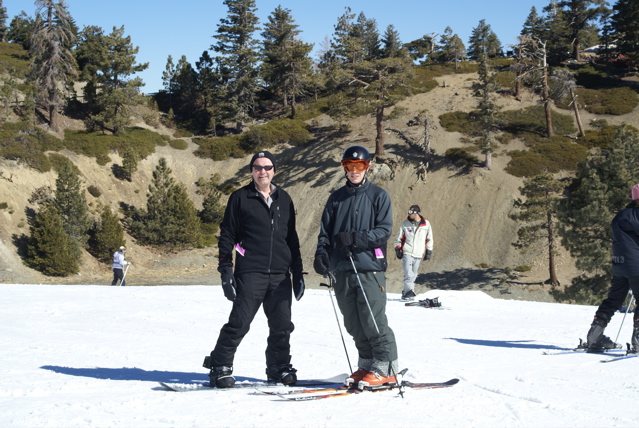
    In February when it was cold and rainy in Seattle a break to visit Will seemed in order.  We went down to Claremont for Family Weekend and I took along my snowboard boots and bibs.  We stuck around the Sunday after the festivities and picked Will up at 10:00 in the morning for a ski trip.  Once we figured out how to fold down the back seat we fit Will into the front and his gear into the back of a small Chevy.

    I drove this time and the trip seemed much shorter and less scary.  Once we got Odette talking about religious experiences she even seemed to relax her death grip on the door handle.  There was no visible snow  on the way up and the parking lot was sunny and dry.  Will didn’t want to take his skis with him but I cajoled him and he gave in when he saw other people with skis on their cars.  They gave us a 50% PSIA discount.  Odette got a $15 sightseer ticket.

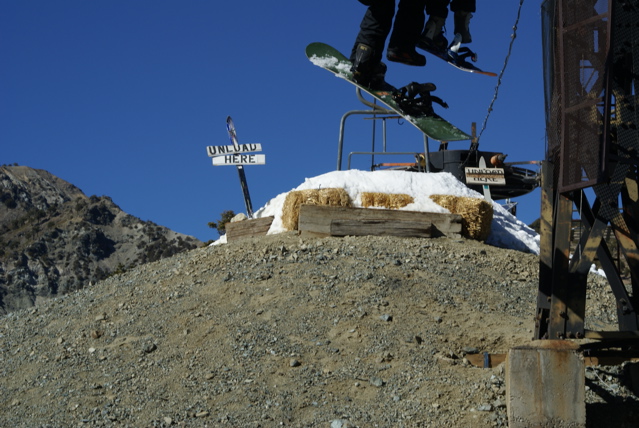
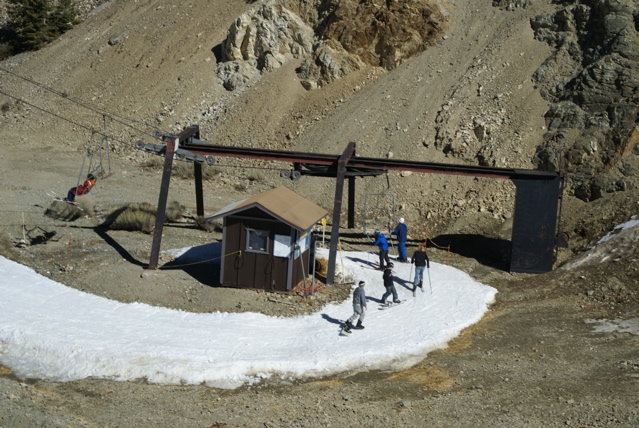
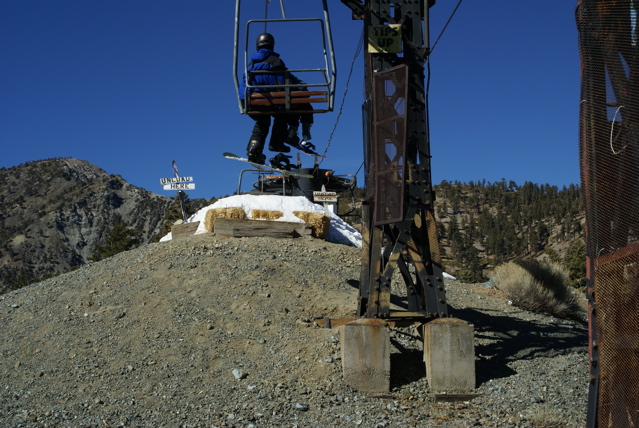
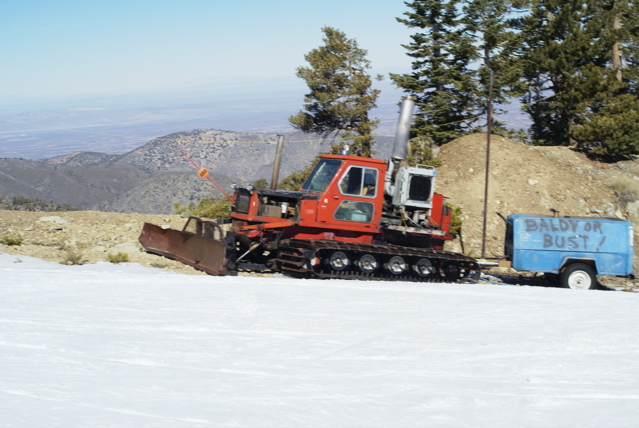
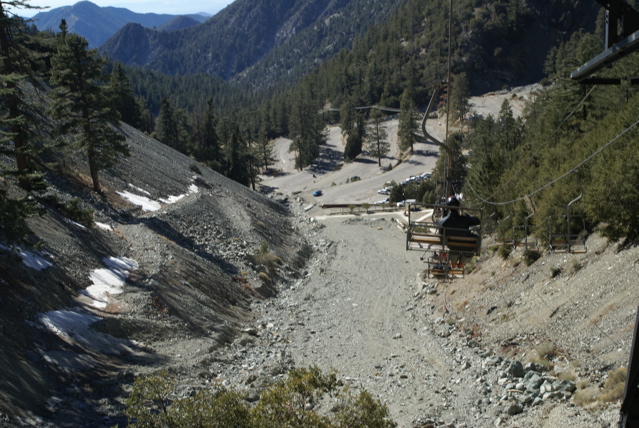
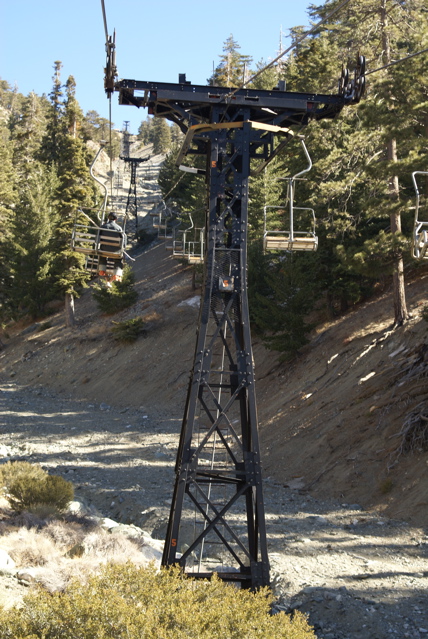
    We only saw traces of snow on the way up lift one.  The lift towers were identical to those on the old Thunderbird lift at Snoqualmie.  The guy at the top station was wearing a ski mask.  There seemed to be a small patch of snow for beginner lessons, otherwise desert.

    I went to the rental shop and discovered that I’d forgotten my regular glasses.  I guessed at what went in which block on the form and for $25 they gave me the most beat-up board I have ever seen.  The base looked kind of like it had been worked over with a cheese shredder.  The bindings were too close together and they were set up duck-footed with way too much front angle.

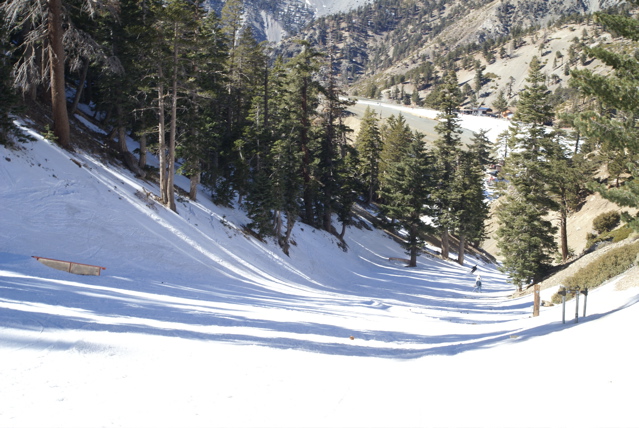
    We skiied down between big rails and around a corner into a gully with a single cat track width of snow which we followed to the bases of two lifts.  We took the bigger one and rode it up to the top of the ridge where a single cat track of snow took us back down to the bottom.  It reminded me of Timberline in August.

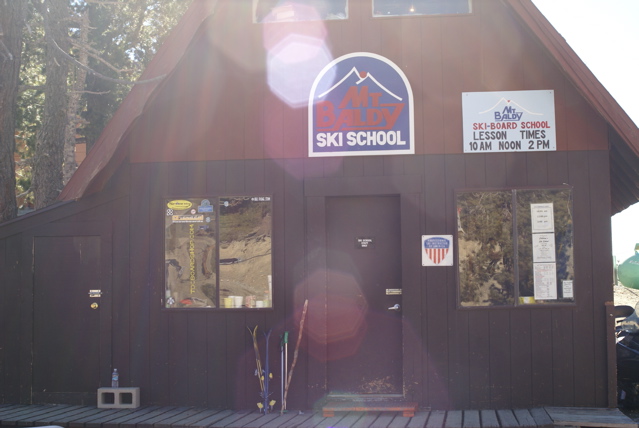
    After two runs we took the baby lift back to the lodge and had lunch with Odette.  Two more runs with the camera (on one of which I lost my lens cap) and we were done for the day.

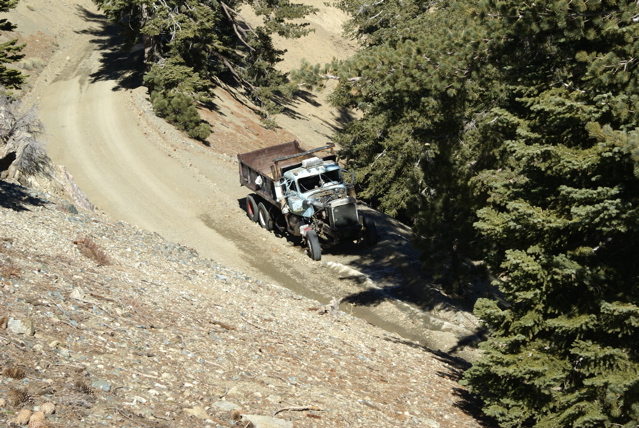
    I’m not sure you could call what we did skiing, but it was actually fun.  With four feet of snow the place would be awsome.  Overall it reminded me of Meany – old gear, decrepit vehicles all over the place, buildings patched together – marginal climatic conditions – but potentially huge fun.  The bowl where the intermediate lift is located looks entirely skiiable with well spaced trees.  The upper lift wasn’t running so I don’t know what that terrain is like but it looked big and wide open.

    The ride down was uneventful (except that I made a fool of myself blurting out when the folks in front of us couldn’t figure out how to get on the chair.)  I don’t know if I’ll ever get back, but now at least I won’t be one year older when I ski the San Gabriels!

    here’s a link to the gallery

  • Stamp Essay

    My father was born in 1909, the son of a South Dakota ditch-digger. Somehow he made it to college and ironically enough his first job after graduating was constructing the sewage system in a CCC camp somewhere in Wyoming. He taught math and shop, got trained as a machinist and ended up making prototypes for Lockheed in Los Angeles during the second world war. He rode a big Indian motorcycle and almost lost a leg in an accident, after which he moved to Oregon, got a Masters and went back to teaching. He was active in the teachers union and didn’t stay in one district very long, for some reason. In 1954 he became a parole and probation officer for the state of Oregon. His district comprised the north-eastern quarter of the state so he was really isolated from his boss and got to spend his time hanging out with rural guys who were mainly in trouble for non-support or game violations. He kept a couple of cows on five acres outside of town, hunted, built a cabin in the woods (he fell off and broke his back when I was in high-school) did a lot of woodworking, and aged unapologetically. I don’t know whether he got senile first, or if it was the strokes that left him unable to talk and depressed, but by the early 90’s he was in bad shape and he died in 1996.

    Somewhere in the mix he collected stamps for a couple of decades. I never really talked to him about it, but he must have started while he was in California in the late 40’s and faded out during the late 60’s. At one point he managed a round-robin approval club. For some obscure reason he collected Hungarian stamps. He had a big US album that was primarily used stamps, and a couple more that were primarily mint. He had a big foreign album and separate albums for Hungary and Germany. His style was to soak off stamps from all of the mail that came his way and he evidently traded for lots of things with the guys in that approval club. His used albums look disorganized and messy. He inserted extra pages for stamps that weren’t included on the pre-printed pages and when he got too many pages for a particular country he would pull them out and set them up as a separate album. (He taught drafting and the lettering on those extra pages is right out of world war II.) He mounted lots of stamps in the margins because they weren’t listed on the pre-printed pages, and he left lots of loose stamps tipped in under the hinges. He generally indicated the catalogue number in pencil either under the stamp or on its reverse side. His big US and international albums are more like an inventory than showpieces – but in his Hungarian album it is obvious that he took a lot of trouble with the presentation. When the approval club wound down he ended up with all of the residual approval pages – and he had lots and lots of duplicates of his own. He stored the duplicates in envelopes (many in little church donation envelopes!) and pouches home-made from cellophane taped to 3X5 index cards. He also had various shoeboxes and even a paper bag with over a thousand 1938 3C Jeffersons inexplicably labeled "do not open before 1992".

    During the later part of this time my Mom had a Canadian album, a UN album, and made a habit of buying a sheet of each commemorative as it came out. Her style was to buy mint sets but to leave stuff in the envelopes rather than mounting it. She also had a topical scouting collection, mainly purchased from dealers, part of which was carefully mounted and part of which was not. I don’t remember ever seeing it as a kid, but the album was set up to look as if it was mine. (I remember that my older brother had set of some kind of stamps framed and hung on the wall, probably done for a boy scout merit badge. My Mom must have expected me to follow suit.)

    After my Dad died my Mom stayed in their house for several years but she got less and less able to care for herself and a few years ago she moved to the Alzheimer’s unit of an assisted living facility and we cleaned out the house. I agreed to take the stamps and see if I couldn’t figure out how to sell them. The advice I got from the friends I consulted was that the first step was to catalogue the collection, so I set out to identify and list all of my fathers’ stamps.

    It helped that I was unemployed at the time because it was a much bigger job that I imagined. First I had to organize stamps by country since in the intervening years the shoeboxes and envelopes had gotten scrambled. I sorted out the US stamps and got a software program called "StampKeeper" (a Microsoft FoxPro application from CompuQuote with a database of US stamps and catalogue values) so that all I had to do was figure out how many of each type of stamp I had. I bought a six-volume 1996 Scott catalogue in a Friends of the Seattle Public Library discard sale to replace the two volume 1953 and 1955 Scott catalogues I found in my fathers’ stuff.

    I quickly decided that I wasn’t going to worry about mounting anything because the effort to make the albums pretty was too much to even consider. (There were a lot of crystal stamp protectors in one of the shoeboxes, so when I found single stamps that weren’t in the album I put them in using a mount rather than a hinge.) If I only had one duplicate of a stamp I decided to tip it into the album. If I had more than one duplicate I put it in a zip-lock bag (eschewing those homemade pouches with fifty-year old tape) and I bundled the bags together in batches of ten or fifteen. I experimented with several ways to bundle the bags and settled on two-prong paper fasteners and 3X5 index cards. I bought a two-hole punch and punched the top margin of the zip-locks so that they still zipped properly but I got a nice secure bundle that lays flat. I started numbering the batches of bags as ZL-1, ZL-2, etc. and discovered that StampKeeper couldn’t sort on numbers with hyphens or spaces in them. For subsequent albums I put a prefix or suffix on the ZL and tried to do without hyphens and spaces. I also decided that I couldn’t necessarily take my fathers’ word for the Scott number of a given stamp since his numbering was not always the same as in the 1996 catalogue.

    My first challenge with the US collection was the early American Washingtons and Franklins. I figured out how to identify the differences in scrollwork and detail and I figured out how to use a perforation gauge, but I decided that I didn’t want to learn how to distinguish by watermarks. If I couldn’t tell which of two stamps I was looking at I assumed it was the one with the lower value. I also decided that I wasn’t qualified to rate a stamp "very fine", as opposed to "fine." I listed anything without a postmark as "Mint" and anything cancelled as "Used." Most of the older mint singles don’t have any gum and almost all of them have been hinged. (Pretty much everything in the albums is on hinges.) I tried to comment on everything that struck me as significant about a stamp – usually indicating if there were any blocks included, if there was anything about the stamp that differed from the catalogue description, or the distinguishing features if it was an overprint or somehow related to an earlier issue.

    The mint sheets were in page protectors and I left them that way. The annual mint sets were in USPS envelopes and I left them that way. There was a fair quantity of postal ephemera (duck stamps on hunting licenses, first day covers, old post cards, postal letters, cut squares, etc.) which I organized as best I could either in zip-lock bags or manila envelopes. I didn’t remove anything from the paper it was on, so the bag of stuff that my father didn’t get around to soaking off is still on paper.

    The Canadian and UN collections were smaller and easier than the US collection. Those albums were my Mom’s and are somewhat prettier than my Dad’s, too. I bought the CompuQuote databases for those sets as well, and numbered the zip-lock bags separately. I left the mint sets in the original envelopes from the respective postal agencies. By this time I had returned to work and I realized that I had about 600 hours and about $300 into the project. I didn’t do much more with it for almost a year and then decided that I needed to finish it up.

    The international stamps were in a big album and a huge scrambled pile. There was also a second album that was almost entirely empty and a couple-dozen approval sheets from the early 50s. Idismantled the second album and the approval pages and organized everything by country. I spent another couple hundred dollars and bought the CompuQuote databases for Great Britain and Germany and some more zip-lock bags. I entered the British stamps and then added the British colonies in the same file. For this reason the catalogue numbers I’ve recorded for Australia start with "AU", for New Zealand with "NZ", etc. There were a lot of stamps from the British Commonwealth. There were also a lot of German stamps – including quite a few from East Germany. I decided not to buy the CompuQuote database for East Germany and entered them in the German file as I had done with the British colonies.

    CompuQuote also makes a program called "StampWorld" that gives you a blank database for topical collections and for countries where they don’t sell the catalogue information. I bought that program and entered my Mothers’ "Scouts on Stamps" album. (I stuck her unmounted Scouting stamps onto the blank pages in the album using old crystal mounts, so the back part of the album looks pretty ugly.) My next step was to catalogue the Hungarian album and the loose Hungarian stamps. Then I worked through the rest of the countries one by one. For whatever reason there are a lot of Eastern European stamps – especially Austria, Czechoslovakia, Poland and Romania. There are a lot of stamps from the European colonial powers (France, Italy, and Netherlands) and some from their colonies. There are fairly large batches from Norway, Denmark, Finland, Sweden and Switzerland and quite a few Chinese stamps. Then there are small collections from lots of Latin American and European states. I figured I was up to 1,000 hours by the time I got the international stamps organized and listed. I stored the albums and the bundles of zip-lock bags in flat clear plastic boxes (like you’d store sweaters in) in a cold closet. I ended up with twelve boxes.

    Once I had everything in the data base (except for a handful of weird stamps that I chased for months afterwards, most of which ended up labled "not in Scott") I needed a way to pull seven files together to print a complete list of the collection. I started to buy FoxPro with the idea of merging the files into a single database, but then decided that it would be cooler to port it to a SQL database available over the web instead of printing reports or mailing CDs. Since my son, Will, had a webserver running under Linux the obvious course was to install MySQL and convert the proprietary CompuQuote stuff to a SQL format. I agreed to let him have the better computer if he would get MySQL up and I bought him a copy of WebObjects in exchange for a promise to use it to make the web front end for the stamp database.

    The US, US plate block, Canada, Great Britain and German files were relatively easy to convert to SQL since StampKeeper produced an inventory report that showed the comments and allowed a "print-to-file" option. I imported those inventory reports into Excel and then used a utility to turn the Excel files into SQL tables. There was a glitch in that while importing into Excel the column width for the catalogue number was set too small and anything with a three-digit country prefix and a catalogue number over three digits long overflowed into the denomination column. Once I figured out what had happened I had to look at every record to see if a correction to the catalogue number and denomination was required. SQL also didn’t like commas or quotation marks, so I had to look at each record to see which comments and descriptions had problems and edit them one at a time. Finally, Excel didn’t include any trailing zeros so while I was editing records I fixed the missing stuff to the right of the decimal point – impacting most of the records for the US, Canada and the UN. I edited these files with a legacy version of a Linux utility called Webmin – meaning that I could only see twenty-five records at a time, that I had to select each record I wanted to edit, wait while it unlocked those records, make my changes in a field showing only five or ten characters of a text string, and then save that screen.

    The StampWorld files were another story. That program didn’t produce an inventory report for the full collection, only country by country. Its inventory report also didn’t display the comments if they were more than about fifteen characters long. Their technical support was distinctly unhelpful. To make a long story short I ended up opening the main .dbf file in Excel and retyping all of the long comments. When I imported it into SQL I had the same problems with commas and quotations so that I had to review all of the descriptions and comments and fix those problems. In addition, somewhere in the process I set the catalogue number as a numeric field with a width of five, and one of the programs inserted zeros to give me five numbers. This meant that something that should have been C102 became C00102 and something that should have been 9NO3 became 9NO0003. Needless to say all of this editing was done in Webmin.

    About halfway through editing the international file I hit save and nothing happened. One thing led to another and eventually Will dropped the table and told me I’d have to redo the work on the international file. The issue turned out to be that Linux was installed wrong (in someone’s haste to claim a new computer) and I’d run out of space in the directory where the MySQL tables were located. It took a couple of weeks and a couple of different Linux distributions before the Meany Lodge webserver was back up and I could go back to editing. I went through the international file record by record with the reports from StampWorld and to make sure that the data was correct – touching every record at least once more in the process. I also learned how to backup the database for myself.

    Once we had all of the tables set up I realized that the StampKeeper files didn’t have "country" fields so I added them. This wasn’t trivial for Great Britain with thirty or so colonies or for Germany with occupied territories, occupation zones, predecessor states, the DDR, etc. The process of setting up those fields made me think through the definition of "country" and the country / colony relationship. In StampWorld I hadn’t wanted to set up any more country files than necessary so I’d put a lot of colonies where I only had a few stamps in with the mother country indicating the colony issue in a comment. Now I had the ability to select a country and show all of the related colonies individually – but only if they were identified in the country field. So I went back into the international and Great Britain files and edited the countries and comments for all of the colonial powers. (There is still a limitation – originally I had Australia as a comment in stamps with Great Britain in the country field. Now Australia is in the country field and is shown as a sub of Great Britain in a countries table – but New South Wales and Victoria are still shown as comments in stamps with Australia in the country field.)

    I also added a "type" field to the plate block file (and checked to make sure that all of the blocks without plate numbers weren’t designated as "PB". In setting up the StampKeeper and StampWorld files I had been inconsistent with the type specified for non-plateblock blocks of stamps. I commented every block, but sometimes I entered the type as "B2", "B4", etc. Sometimes I entered the type as "MS" or "US". After going through the plate block file I decided to go through the other files and remove the "B" types. While doing that I tried to make sure that all of the cut squares and material on envelopes was identified with a type ST (for "stationary") and I tried to eliminate all of the other non-standard type designations.

    Meanwhile, Will got disillusioned with Web Objects because of Java issues and shifted to CGI / PERL scripts. We had a lot of fun discussions about why he needed to write and debug CGI instead of just learning MySQL functions. He did a complicated search and sub-search function in CGI and then discovered that the new version of Dreamweaver made the next step distinctly easier. He converted the CGI script to PHP and redid the whole stamp page in Dreamweaver. I figure that between the two of us we’re approaching a full man-year now and still need to refine the search and printing capabilities.

    Despite having invested a huge amount of time in a bunch of stamps with uncertain value I’m pleased with the project for the following reasons:

    • Will and I both learned some history.
    • We both learned a lot about open source software.
    • Will learned some things about SQL databases and dynamic HTML.
    • I really enjoyed the intellectual challenge of identifying stamps and figuring out where particular issues fit into the historical record.
    • I discovered that the mindless part of the process (data entry and editing) was a good escape.

    I’m basically not a collector and I still want to sell off this batch of stamps. One thing that I learned from this is that I don’t want to saddle Will with anything that he would have to deal with when I can’t. However, during the time I’ve spent on these things I have in fact grown attached to them. The whole time I was sorting stamps and pouring through albums and envelopes and stuff I kept thinking that I’d come across a note or some kind of communication intended for the next person who looked at this stuff. There wasn’t any message – and I was sad about that. It did give me some insight into my parents, though, since I’d never seen (or at least never appreciated) the collector side of them. (Come to think of it as a kid I remember family projects based on collecting twine from hay bales, apricot pits, wild mushrooms, and many other things even more obscure than postage stamps!) They both grew up in the depression so it makes sense that they wouldn’t want to throw out things with value – even the miniscule value of a used stamp. They didn’t have much, so it makes sense that their collection would be high quantity with low individual values. (I can’t imagine my father paying $50 for a rare stamp but I know that he would spend hours sorting through loose "kilo-ware" in case there was something valuable there.) I suspect that he (they) got into stamps at least in part as something to do with the kids – and when the kids weren’t very interested it took on a life of it’s own. This may be something intrinsic to the act of collecting because it has certainly recapitulated itself for Will and me.

  • Unpaved Trails

    adventurecorps


    Stoked on Tandems

    By Chris Kostman

    Originally published in California Bicyclist, August 1991

    Chances are, if you’ve yet to get stoked on tandems, then you’re probably a closet smart aleck just waiting for the chance to thrill us with your wit and humor. Trust me. We tandem riders have heard it all. It’s like a non-stop amateur comedy show when we’re out frying the highway or the trails on the two-fer: “Hey! Which one of you is doing all the work?” or “How come the guy on back has his feet up?” Being the friendly sort that I am, I’ve yet to retort with something truly deserving, witty, and appropriate, but if I did… “Well, guess what, Jay Leno wanna-be? This bike has one freewheel, not two, so the bike only goes as fast as both pairs of legs make it go!” But that wouldn’t be good for the bikie image and promoting universal harmony, so I just bite my lip instead.

    Of course, that’s only the beginning… It is absolutely inevitable that when I’m captaining and the stoker is a female, we hear something along the lines of the following. To me: “That’s some cute baggage you’ve got there!” or “How come you’re doing all the work?” or to her: “Smart move. You’ve got him doing all the work!” or “Looks like you’re just along for the ride!” Yep. The retreads are out in force when we roll by on the tandem. What blows me away is that we hear this type of stuff from women half the time! Sexism is bad enough without the women participating. Not to mention that Elaine Mariolle is the stoker most commonly found sharing Mr. Moots with me. If those clueless nimrods only knew who she is! (She’s as far from the baggage department as anyone, male or female, can be! However I will grant that she is cute, very cute… Of course, even if your female stoker is not a RAAM winning studette, there’s no reason for anyone to assume that she’s any weaker than her male counterpart.) At any rate, do us tandem riders a favor and heed this advice from Scot Nicol of Ibis: “Before you say something stupid, realize it’s been said fifty times before.”

    All of this begs the question “why is the woman usually riding in the stoker’s seat?” Simple: The laws of physics and the designers of tandems decreed that the heavier rider should captain and the lighter rider should stoke. So… since women are generally lighter and smaller than men, they usually stoke. No sexism, machoism, or mindless libido flapping going on, just plain old physics.

    Here’s how Nicol explains it: “When a tandem is steered around a curve, the frame ‘winds up’ before the rear wheel tracks the same curve. In other words, the captain sets the line, the frame gets thrown to the side by the stoker’s weight, then the rear wheel follows on a slightly different line.” This effect, called stoker lag, increases exponentially as the stoker’s weight goes up or as the tandem frame’s torsional rigidity goes down. To the captain, this unnerving effect feels as if an invisible pair of hands suddenly yanked on the bars. Here’s how to avoid this dreaded effect: Buy a torsionally rigid tandem, such as those from Ibis, Moots, Ritchey, or Santana to name my fav’s. Put the heavier rider up front. The stoker should stay smooth, calm, centered over the center of gravity, and avoid quick movements.

    My first tandem was a British made Dawes, a bike not exactly overflowing with torsional rigidity or a lengthy rear top tube. I took my buddy Jim Offutt (6’4″ and about 200 vs. me at 5’11.5″ and 145) out once and nearly turned us into road pizza every time he reached for a water bottle. Needless to say, Jim learned to captain quick. My regular tandem partner back then was fellow RAAMer Jim DeGraffenreid who was absolutely ideal in terms of the physics involved. We were essentially identical in height and weight, so we balanced the bike well, and could switch positions at a moment’s notice with no adjustments to the bike. Way cool and way rare.

    Another reason to put the heavier rider up front is to suspend his or her weight in the middle of the bike instead of right on top of the rear wheel. This makes it more comfortable for him or her, plus is a bit easier on the bike.

    So why ride a tandem? If you need to ask, then you’re not too observant, but let me illuminate you with a few of my favorite reasons: On flats and downhills, tandems are simply faster. (And who wouldn’t want some free speed?) Even on an uphill, where tandems supposedly lose some ground, a well synchronized pair on a stiff steed can at least keep up with the singles, if not even drop all the solo artists. And it’s a kick to share the ride with someone, especially someone that you don’t have to worry about dropping. Elaine adds, “if you’re going to hurt, you might as well hurt with a friend.” Plus, despite all of the bozo comments which I outlined above, a tandem is truly a universal smile machine. Other riders consider you a novelty, cars give you more space (gasp!) and … drum roll please… off-road tandemists are greeted with a positively friendly smile of incredulity by the same fellow trail users (read: hikers/horse-types) who would only begrudgingly give up any trail space to a pair of mountain bikers on singles. (I hope I haven’t let the cat out of the bag with this last pointer. This is one of mountain biking’s best kept secrets!)

    So what type of tandem should you get, you ask? In other words, a road tandem or a mountain tandem? A good question with a simple answer. Buy a mountain tandem! The good ones are all superior in terms of torsional rigidity, the 26″ wheels are sturdier and will accelerate quicker, and you have the option of paved or unpaved riding surfaces. Throw on slicks and hit the road or knobbies and hit the trail. Or take either setup into either locale. The extra weight of the bike and its two pilots gives supreme traction on either wet roads or on gnarly single track. In fact, it’s downright amazing what a tandem can do on technically challenging riding surfaces. Except for their larger turning radius, tandems are awesome off-road! Also, a mountain tandem is sized smaller, allowing a greater range of rider sizes. (How else could Elaine and I fit on a stock sized tandem?) Besides, a well made mountain tandem will plain outperform any road tandem. Nicol, whose company is largely dedicated to building and promoting mountain tandems, puts the comparison of road versus mountain tandems this way: “We’ve designed our bikes for the people who are graduating from those other bikes.” In other words, mountain tandems are the higher evolution of the tandem species. Nicol said it. I agree. I wrote it. And what’s in print must be true.

  • Book Keywords

    KEY WORD SEARCHES.

    climbing – all books about getting to the top of stuff
    climb guide – "where to" guides
    climb technique – "how to" books
    climb gear – small number of books about hardware
    climb literature – literature (mainly climbing narratives) about climbing, much of it away from the Cascades

    hiking – all books about trails and puting one foot in front of the other
    hike guide – "where to" guides
    hike gear – small number of books about gadgets
    snowshoe – books about hiking in the winter

    biking – all books about bicycles
    bike guide – "where-to" guides
    bike tour – technique for multi-day bike trips
    bike gear – hardware (mainly maintenance and repair books)

    skiing – all books about glisse sports
    ski tour – overnight ski trips
    ski mountaineering – sumits on skis
    ski technique – bend the knees, $5 please
    ski gear – tuning, waxing, etc

    mountain rescue – SAR
    first aid – injury treatment
    avalanche – snow slides

    natural history – all books about the environment
    plants – vegetable kingdom
    animals – birds, fish, mamals, etc.

    history – recorded (human) occurances
    railroad – books about one of the driving forces of our regional history

    geology – earth sciences
    mining – extractive industries

    photography – design and production of images
    paddle sports – kayak and canoe

    San Juans – islands in the north sound
    North Cascades – pretty much north of Mt. Rainier
    Mt. Rainier – the mountain you see from Seattle
    South Cascades – south of Mt. Rainier
    Eastern Washington – east of the crest (enchantments, chelan, teanneway, paseyten)
    Olympics – the peninsula (national park, beaches, mountains)

    Puget Sound – the metropolis

    Mt. Hood – the mountain you see from Portand
    Western Oregon – west of the cascades
    Eastern Oregon – high desert
    Wallowas – northeast mountains (eagle cap wilderness)

    British Columbia – vancouver island to the rockies
    Idaho – famous potatoes
    California – left coast
    Alaska – sourdoughs
    Southwest – arizona, new mexico, utah


    Europe
    – excluding the russian far east
    Himalaya – all of the big mountains
    Latin America – mexico, central america, south america